Your Calendar Is Full All Day—So When Are You Supposed to Do the Actual Work?

Your Calendar Is Full All Day—So When Are You Supposed to Do the Actual Work?

Leadership & Management
At 9:00, there is a team check-in. At 10:00, another meeting starts to discuss a project update. After lunch comes a planning session, followed by a quick sync that somehow lasts 45 minutes. By late afternoon, the calendar finally becomes quiet. Now the actual work can begin. This pattern is common in growing teams. Meetings are created to improve communication, alignment, and decision-making, but too many of them can consume the very time employees need to execute those decisions. Learning how to reduce unnecessary meetings does not mean eliminating collaboration. It means understanding which conversations genuinely benefit from everyone being together at the same time—and which ones can happen more efficiently in another format. Meetings Are Not Automatically Productive Work A meeting can absolutely create value. A difficult decision may…

Read More
You Hired a Team—So Why Are You Still Doing Everything Yourself?

You Hired a Team—So Why Are You Still Doing Everything Yourself?

Leadership & Management
You have a team, but somehow every important task still ends up on your desk. A client needs a quick revision? You handle it. A report needs checking? You rewrite half of it yourself. Someone asks a question? Instead of explaining the process, you complete the task because it seems faster. At first, this can look like strong leadership. The work gets done, quality stays under control, and problems disappear quickly. But after a while, the pattern becomes expensive. Your workload keeps growing while the people around you never get enough ownership to operate independently. Learning how to delegate effectively is not about finding ways to avoid work. It is about making sure the right work is handled by the right person without turning the manager into a permanent bottleneck.…
Read More
Everyone on Your Team Is Busy—So Why Is the Important Work Still Not Getting Done?

Everyone on Your Team Is Busy—So Why Is the Important Work Still Not Getting Done?

Productivity
Monday morning. Calendar full. Inbox full. Team chat? Already moving at dangerous speed. Someone needs a report. Another person needs approval. A client has a “quick question.” Three meetings appear. A spreadsheet suddenly becomes urgent. By 5 PM, everyone is exhausted. Tuesday? Same thing. Wednesday? Still busy. Then Friday arrives. You look at the project that actually mattered this week. Almost nothing moved. How? Nobody was lazy. Nobody disappeared. Everyone worked. The problem was simpler: being busy and making progress are not the same thing. Learning how to prioritize work effectively often begins by recognizing that modern teams rarely suffer from having absolutely nothing to do. They suffer from having too many things that appear equally important. Busy Is Easy to See Walk through an office. People typing. Calls happening.…
Read More
Effective Leadership Strategies for Managing Fully Remote Teams

Effective Leadership Strategies for Managing Fully Remote Teams

Team Management, Operations & Management
Effective Leadership Strategies for Managing Fully Remote Teams Leading a fully remote team requires more than transferring office routines into video calls. Without a shared physical workspace, managers must create clarity, trust, and connection through deliberate leadership practices. Successful remote leaders focus on outcomes instead of online activity. They give employees enough structure to remain aligned while preserving the flexibility that makes remote work valuable. This balance helps distributed teams stay productive without feeling constantly monitored. Establish Clear Expectations From the Beginning Ambiguity becomes more damaging when employees cannot walk across the office to ask a quick question. Every team member should understand their responsibilities, priorities, deadlines, and decision-making authority. Strong remote leadership begins with defining what successful performance looks like. Leaders should explain the expected result, available resources, relevant…
Read More
“It’s Faster If I Do It Myself”—The Management Habit That Eventually Stops Working

“It’s Faster If I Do It Myself”—The Management Habit That Eventually Stops Working

Default
You ask someone to prepare a report. Ten minutes later, you start thinking: “I could have finished this already.” They ask a question. Then another. You explain the process. Review their work. Find something you would have done differently. And eventually think: “Forget it. Next time I'll just do it myself.” It feels efficient. For today, maybe it is. But repeat that pattern for six months and something strange happens. You are now: managing projects, answering questions, checking everyone's work, attending meetings, and still doing half the tasks you were supposed to hand over. Your team waits for you. Your calendar is full. Everything important somehow requires your approval. And you wonder why becoming a manager created more work instead of less. Learning how to delegate effectively starts with understanding…
Read More
Your Calendar Is Full All Day—So When Are You Supposed to Actually Work? How to Fix Meeting Overload

Your Calendar Is Full All Day—So When Are You Supposed to Actually Work? How to Fix Meeting Overload

Team Management
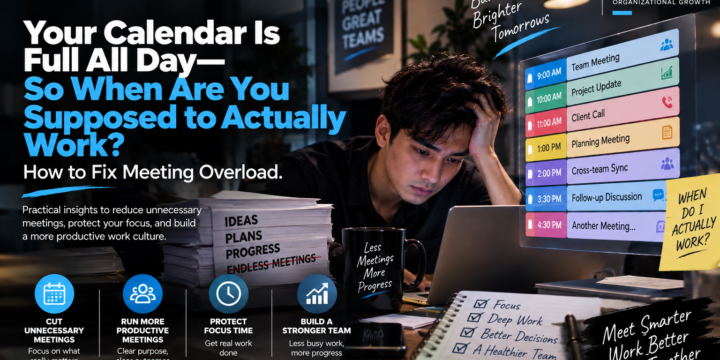
You open your calendar on Monday morning. 9:00 — weekly team meeting. 10:00 — project update. 11:00 — client call. 1:00 — planning meeting. 2:00 — cross-team sync. 3:30 — follow-up discussion. 4:30 — another meeting about something discussed in the meeting at 2:00. Your calendar looks impressive. Completely full. You were busy all day. There is only one problem. When were you supposed to actually do the work? This is the strange reality of too many meetings at work. Meetings exist to help people coordinate work. But when they multiply without clear purpose, the coordination can begin consuming the time required to perform the work itself. The solution is not eliminating meetings. Some meetings are extremely valuable. The goal is learning which conversations deserve everyone's synchronized attention—and which ones…
Read More
Sama-Sama Mengatur Cara Kerja, Apa Bedanya SOP dan Workflow? Jangan Sampai Tim Punya Dokumen tapi Tetap Bingung

Sama-Sama Mengatur Cara Kerja, Apa Bedanya SOP dan Workflow? Jangan Sampai Tim Punya Dokumen tapi Tetap Bingung

Operations & Management
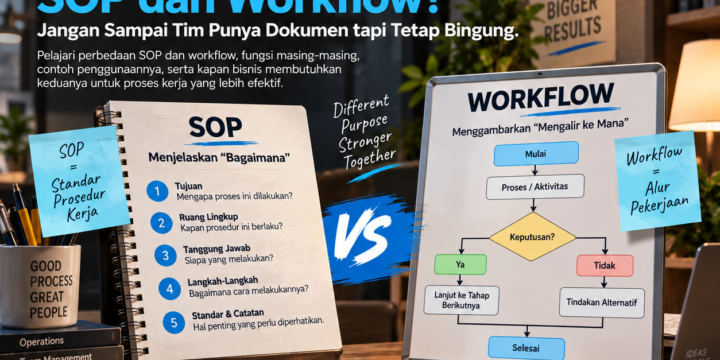
Bayangkan sebuah bisnis menerima pesanan baru. Customer menghubungi sales. Sales mencatat pesanan. Finance memeriksa pembayaran. Warehouse menyiapkan barang. Kurir mengambil paket. Customer menerima pesanan. Kelihatannya sederhana. Sampai suatu hari sales bertanya: “Setelah customer bayar, gue harus kasih tahu siapa?” Finance menjawab: “Bukannya warehouse otomatis tahu?” Warehouse malah bilang: “Gue nunggu approval dari supervisor.” Supervisor? Sedang cuti. Akhirnya semua orang bekerja, tetapi order tetap tidak bergerak. Masalah seperti ini sering bukan karena tim malas atau tidak kompeten. Kadang perusahaan hanya belum mempunyai proses kerja yang cukup jelas. Di sinilah istilah SOP dan workflow sering muncul. Keduanya sama-sama digunakan untuk membuat pekerjaan lebih teratur, tetapi perbedaan SOP dan workflow sebenarnya cukup besar. SOP menjelaskan bagaimana suatu pekerjaan seharusnya dilakukan. Workflow membantu menggambarkan bagaimana pekerjaan bergerak dari satu tahap ke tahap berikutnya. Bisnis…
Read More